How to Read Redactions in Public Tax Case Documents
A black bar, blank space, or missing detail in a public tax-case PDF can make a reader curious. It can also invite a false conclusion. The visible copy tells you that some information is not shown; it usually does not tell you exactly what was removed, who made that decision, or whether the missing words would change the case. Reading a redacted document well means working with the visible evidence and stating its limits.
This article is a guide to careful public-record research, not a method for recovering concealed information. Do not try to remove redactions or expose protected personal details. The examples below are fictional. Rules and access practices vary by jurisdiction and over time, so use current official information for a specific case or request.

Describe what you can see before explaining why
Begin with the visual fact. Is there a solid black rectangle over text? A white area with a label such as “redacted”? A page number that jumps from three to five? A table cell that is blank? These are different observations. A blank cell may have been intentionally left empty. A skipped number may reflect the original packet’s numbering. A black bar may conceal a name, account number, or something else entirely. Do not call every gap a redaction without evidence.
In a research note, specify the location and appearance: “PDF page 4 has a black bar across the second line of the address block.” That is more useful than “address redacted,” which assumes what the hidden text contains. If the PDF itself labels a section as redacted, quote that label accurately. Keep the surrounding visible text so another reader can understand the context without guessing the concealed words.
Check whether the apparent gap is a rendering issue. A PDF viewer can fail to load a page, a scan can crop a margin, and OCR can omit text that is plainly visible. Open the page in a reliable viewer and inspect the image. If a second copy is legitimately public, compare it only to understand the published record; do not use it to defeat an intentional privacy restriction.
The safest starting sentence is often “The publicly available copy does not show this detail.” That says what you know. “The tribunal hid this detail because…” requires independent evidence of the reason. Separate these levels in your writing.
Know that some personal details should not appear publicly
Public proceedings can contain private information. The Michigan Tax Tribunal’s glossary summarizes protected personal identifying information under Michigan court rules, including dates of birth, Social Security or national identification numbers, driver’s license or state ID numbers, passport numbers, and financial account numbers. This is one reason a public-facing filing may be altered before publication or prepared without those details in the first place.
The existence of a redaction does not prove the concealed text is one of those categories. A name, address, business detail, medical fact, or something else may be involved, or the bar may result from a different process. Read any visible redaction legend, order, or rule reference before describing the reason. If no reason is shown, leave it unknown.
Privacy limits are not a flaw for a researcher to work around. They are part of the scope of the public copy. If you prepare notes, screenshots, or excerpts, avoid replicating adjacent sensitive fields that are visible but unnecessary to your point. A public page can be legally accessible while still deserving careful handling, particularly when it names individuals who are not central to your question.
If a document appears to disclose sensitive identifiers by mistake, do not draw attention to the numbers in a blog post or quote them. Use the site’s contact or correction channel or the official source’s process as appropriate. Your research goal is to understand a case, not to expand an accidental disclosure.
Distinguish a redacted copy from an incomplete copy
A redacted copy normally has pages that render, with particular content visibly masked or omitted. An incomplete copy may fail to include an offered attachment or may have pages missing from the file. A scanned page with a cropped edge is a quality problem. A blank PDF search result may be an OCR problem. These should not be grouped under a single “redacted” label.
Inventory the document. Record the visible PDF page count, any printed pagination, and any attachment list on the docket page. If the record lists four PDFs and only three open, the missing fourth file is an availability gap, not proof of redaction. If a five-page PDF has a black bar on page two, it is a readable file with an obscured region. Different problems call for different follow-up checks.
Page numbering deserves caution. A PDF can contain a cover letter followed by an exhibit numbered starting at page one. A jump in printed numbers does not prove a missing scan. Conversely, a PDF viewer displaying every available page does not prove the source packet contained no omitted pages. Look for an index, exhibit list, or page-count statement in the document before concluding anything.
If a public notice says an attachment is confidential or sealed, preserve that wording and do not infer its contents. The record may disclose that a filing occurred without displaying the filing itself. The public view is the boundary of what you can verify from that source.
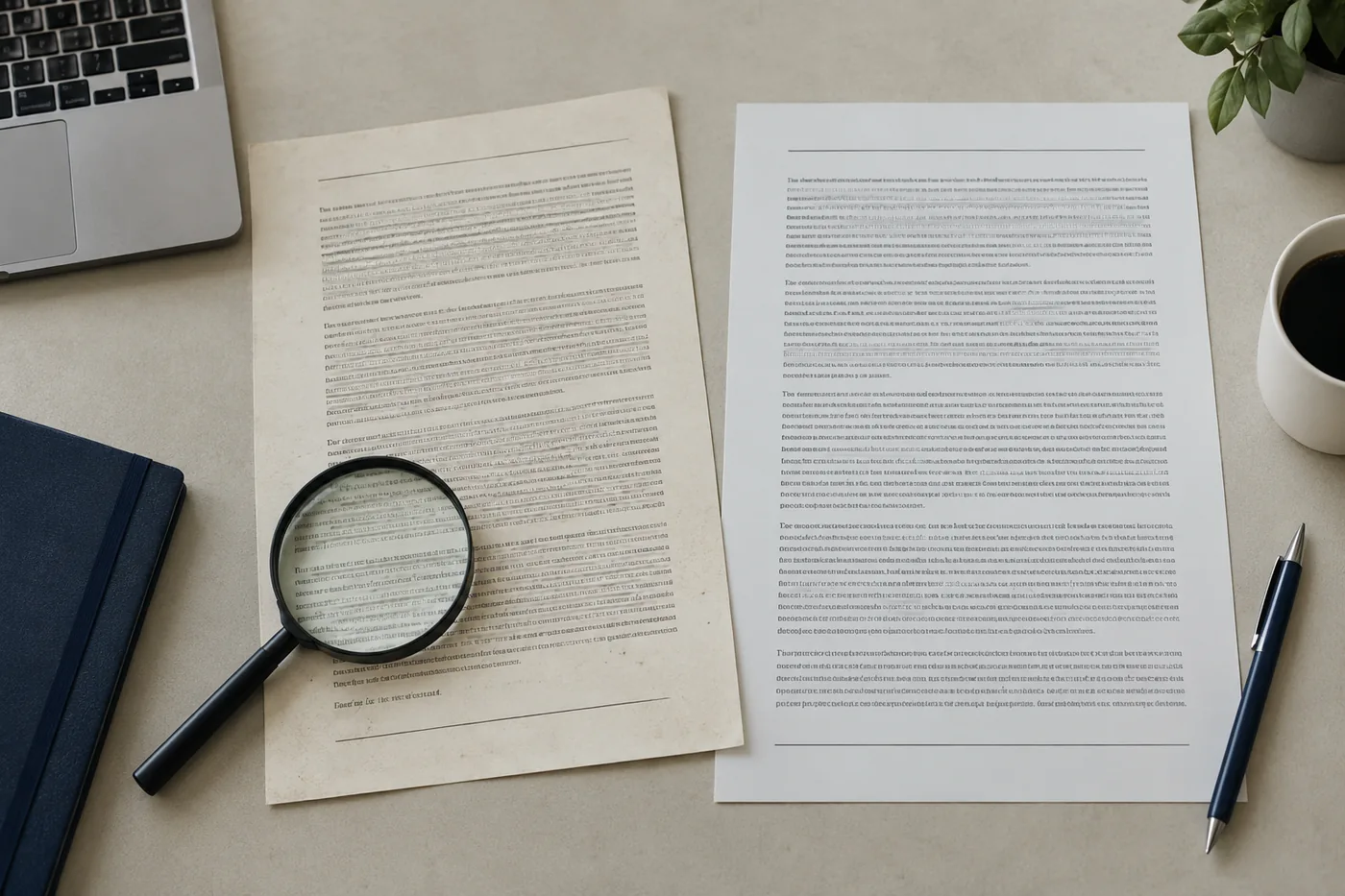
Read the remaining sentence in context
The words around a blacked-out segment can tempt a reader to complete the sentence. Resist that. Grammar can suggest a type of information without proving a specific value. A phrase such as “sent to [redacted] on May 3” tells you the public copy reports sending something on that date; it does not identify the recipient. If the date itself is visible, you can discuss it, but only within the sentence’s actual meaning.
A redaction can hide a small unit inside a larger claim. If a tax-year figure is masked, a visible total elsewhere may not let you compute the missing value; totals can have adjustments, rounding, or categories you have not seen. Do not treat arithmetic reconstruction as evidence of concealed content. A public archive may also present an OCR layer that accidentally includes text under a visual box. Do not quote hidden-layer text as if it were intentionally public.
When a conclusion depends on masked material, state that you cannot verify it from the public copy. You can still report surrounding facts. For example, “The order discusses an exhibit on PDF page 3, but the exhibit identifier is not visible in the publicly available copy.” This helps readers understand both what the source says and why you cannot go further.
Context may also show that the concealed region is irrelevant to your research question. If you are checking the date of a hearing notice, a redacted account number in an unrelated attachment need not affect that finding. Do not let the presence of a black bar turn every visible statement into uncertainty; locate the actual dependency.
Compare page text with visible pixels carefully
PDFs can contain a rendered image, an OCR text layer, annotations, and metadata. These layers may not match perfectly. An OCR extraction might skip a visible heading or read the letters beneath a mask if the file was prepared incorrectly. For public research, use the visible page as the main reference for what the public copy displays. Treat extracted text as a search aid and verify claims against the rendering.
Do not copy a suspicious hidden-layer string into notes or search for it elsewhere to identify a protected person. If a PDF seems improperly sanitized, report the issue through an appropriate channel. The safest article about that document avoids repeating the concealed information. A technical mistake does not make republishing sensitive data necessary.
Screen-reading accessibility complicates this subject. A properly prepared accessible copy should communicate meaningful visible content to readers using assistive technology. A poor scan or text layer may make the document hard to navigate even when the visible pages look fine. Describe accessibility or OCR limits as limits of the copy; do not infer substantive facts from failed extraction.
If the page is rotated, faint, or clipped, the problem may be transcription rather than redaction. Inspect a corrected reading copy when one is available. Keep a note of which version you used, because a later scan can clarify visible text without changing the underlying filing.
Preserve the source and date of your observation
An archive may update a PDF after a correction. A public record may become more or less detailed after a review. Keep the document URL, case number, title, page number, and the date you observed the version. If you make a claim that a field was not visible, the access date is essential: it limits the statement to the copy available at that moment.
Avoid relying only on a filename. A site may serve a new PDF under the same address. A private checksum can distinguish versions without requiring you to publish the file. If you retain copies for a legitimate research purpose, handle them securely and follow applicable rules. Do not redistribute a version that exposes information later properly redacted.
When comparing an independent archive with the official docket, say which copy you saw. “The archived PDF showed a masked field on October 13; the official PDF was not checked” is an honest note. If both sources differ, describe the difference without assuming that one caused the other. The official site may have changed, the archive may have an older version, or the files may be distinct attachments.
The National Archives’ general citation guidance emphasizes identifiers that let another person find the same record. For redacted material, a location and access date also help a reader understand which public version was under discussion. Cite the visible copy, not an imagined unredacted original.

Use careful language in summaries
Compare these statements: “The taxpayer’s account number was hidden”; “A number in the payment section is obscured”; and “A black bar appears in the payment section.” The first identifies the concealed item as an account number. The second makes a narrower inference from context. The third is purely visual. Choose the strongest statement that the visible document actually supports, and no stronger.
The same rule applies to a missing page. “Page 7 was removed for privacy” states both an event and a reason. “The available PDF ends after printed page 6, although its index lists page 7” describes a testable discrepancy. An agency notice or order might explain the gap; if you have not found one, leave the reason open.
Avoid dramatic wording. A black bar is routine in many public-document systems, and a broken attachment can result from ordinary technical problems. Neither is proof of misconduct. Neutral prose protects accuracy and keeps attention on the actual research question.
For a published article, you may decide that the redaction is not relevant at all. If so, do not center it merely because it attracts curiosity. Public-record writing should help readers interpret available facts, not encourage speculation about people whose details were withheld.
A repeatable public-copy check
First, identify the case and exact attachment. Second, open the rendered PDF and note the page count. Third, locate the apparent gap and describe its visual form. Fourth, compare the visible text with any OCR extraction only to catch transcription errors. Fifth, check for an official explanation if the reason matters. Sixth, decide whether your claim depends on the obscured material. Finally, write a dated note with the exact page and the limits of your conclusion.
This routine may end with “unknown,” and that is a valid result. A public copy can establish that a filing exists, that an order contains certain visible language, or that a page has a masked region. It often cannot establish what the mask covers or why a file is missing. Keeping that distinction clear lets you make useful observations while respecting the boundary of the public record.
Decide whether a redaction affects your actual claim
Not every obscured region requires the same level of investigation. Ask what your sentence depends on. If you are reporting that a notice scheduled a hearing, and the date, time, and document heading are visible, a masked mailing address may have no bearing on that narrow claim. If you are asserting who received the notice and the recipient field is masked, the missing text matters directly. Write down that dependency before searching for another source.
This step also guards against false confidence from surrounding pages. A cover sheet may name a party, while a later page masks a recipient. Do not assume the same person fills both fields merely because the file belongs to one case. A document packet can involve representatives, additional parties, or third persons. A cross-reference needs to be explicit enough to support the match.
If a source contains a visible redaction notice or order, read its scope. Does it refer to one field, a set of pages, or a category of documents? A general statement that personal information is protected does not explain every bar in every PDF. Cite the specific notice where possible and keep your wording within its terms. If the explanation is not accessible, “reason not shown in the public copy” remains accurate.
For tables, a redacted row or column can affect a total even when the total is visible. You may report the displayed total, but you may not be able to verify its components from the public page. If you describe a calculation, distinguish “the document states a total of X” from “the visible rows add to X.” Those are different observations. A masked component is a reason to qualify your calculation, not an invitation to solve for hidden data.
Finally, think about whether mentioning the redaction helps the reader. If it is irrelevant to the finding, leave it out of the article and keep a private source note. If it limits verification, say so briefly and neutrally. A useful qualifier often needs only one sentence: “The publicly available copy masks the recipient field, so the recipient could not be verified from this document.”
If another document in the same case mentions the redacted subject, treat it as a separate source. Do not assume it restores the hidden field in the first PDF. It might describe a different event or person. Cite the second document for its own visible statement, and avoid suggesting that the redaction has been undone. A researcher can compare public sources without claiming knowledge of intentionally concealed text.
Review the published summary for accidental disclosure
Even a careful source note can become too revealing when copied into a public article. Before publishing, scan the draft for unnecessary names, addresses, account-like numbers, and clues that combine to identify a person. Ask whether each detail is needed to support the specific point. If a redacted field is not necessary, describe the document’s role without drawing attention to the masked location at all.
Check image captions and alt text as well as body text. A screenshot can expose adjacent fields, even if the sentence discussing it is cautious. An illustration made from invented placeholders often explains the research method better than a crop of a real person’s filing. If you use a source excerpt, keep the source context and avoid implying the masked material was verified.
Finally, reread the headline. A title such as “What the hidden section proves” would promise a conclusion the public copy cannot support. A title about reading visible limits is more accurate and more respectful. Good public-record writing can explain why an unknown stays unknown while still helping readers use the parts of a document they can see.